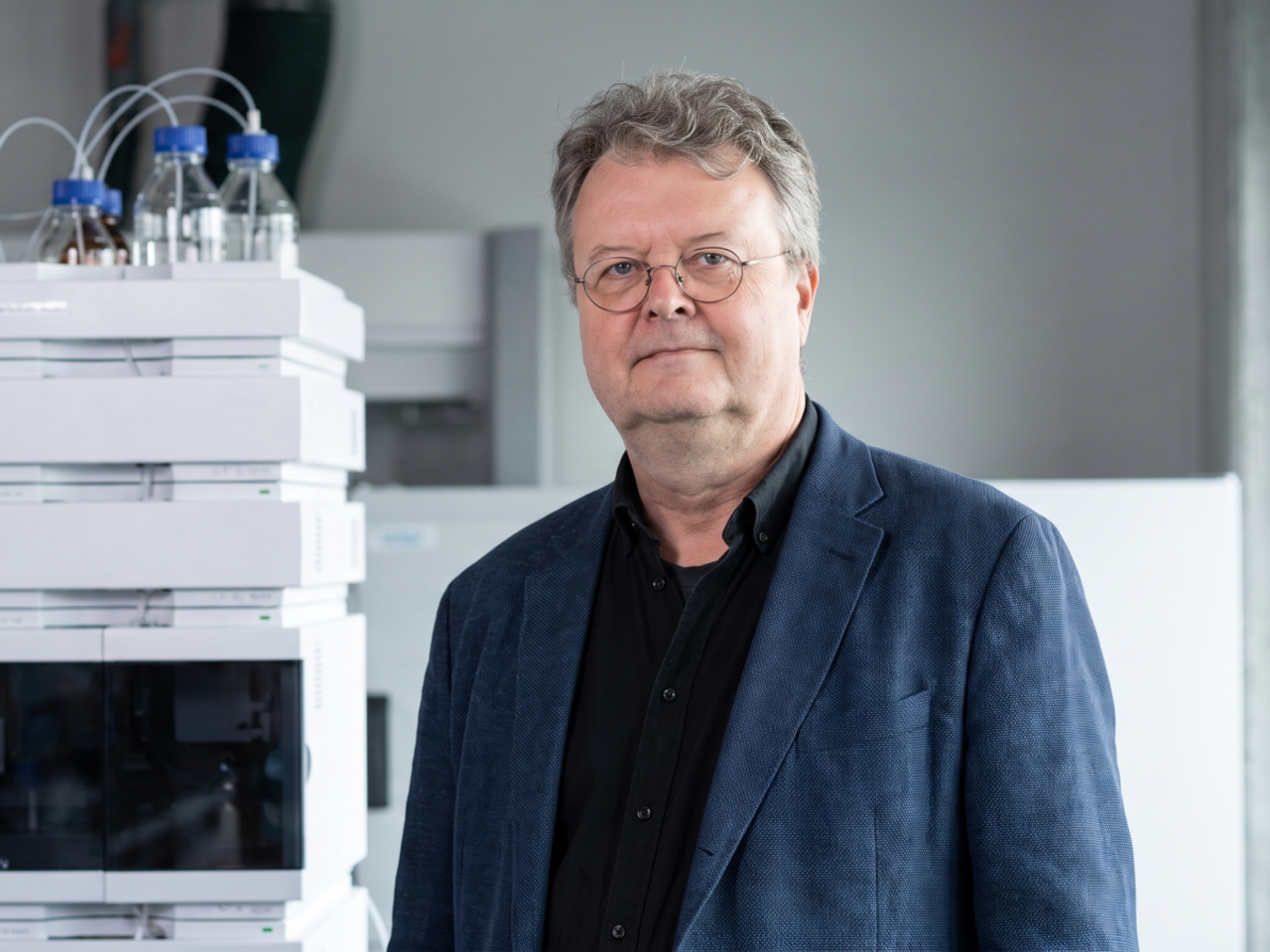
The goal of the new REEactor technology platform is to accelerate and simplify the separation of rare earth elements, reduce waste, and contribute to a more sustainable extraction of strategic raw materials. A team led by renowned chemist Alexander Dömling from the Czech Advanced Technology and Research Institute (CATRIN) at Palacký University will focus on its development thanks to receiving a prestigious European Research Council (ERC) grant in the Proof of Concept category. The platform will combine automated chemistry, artificial intelligence, and molecular research to help strengthen Europe’s position in the field of critical raw materials and advance the goals of the European Green Deal. It is the only grant among the 182 funded under this call to be awarded to a Czech institution.
“REEactor focuses on finding the molecular key to one of the most difficult problems in the processing of critical raw materials: how to identify and separate rare earth elements that are nearly identical. Instead of slowly testing individual compounds, we will use automation to prepare and test tens of thousands of molecular variants, while artificial intelligence will help us identify the most successful ones. This could significantly accelerate the discovery of separation systems that will be more selective, more stable, reusable, and better suited for cleaner industrial processes,” said Alexander Dömling, who received a grant of 150,000 euros for a one-year ERC Proof of Concept project.
According to him, it is difficult to imagine modern life without rare earth elements. This group of 17 chemical elements is essential, for example, to produce batteries, electric vehicles, airplanes, drones, wind turbines, cell phones, medical diagnostic devices, semiconductors, and high-performance magnets. Today’s industrial rare-earth separation capacity is highly concentrated in China and still largely depends on technologies developed decades ago. Because rare-earth elements are chemically very similar, separating them requires long sequences of repetitive extraction steps, large quantities of chemicals and energy, and generates substantial amounts of toxic waste. The REEactor is designed to eliminate these weaknesses. In this project, researchers will utilize the AMADEUS automated research platform, developed as part of Professor Dömling’s previous ERC Advanced project, which is specifically designed to discover new molecular separation technologies much faster than the conventional trial-and-error approach.
However, the REEactor project will not limit itself to discovering molecular variants. Scientists will test the most promising ones under conditions that closely mimic the actual processing and recycling of rare earth elements. This will verify whether the technology works not only in the laboratory but also has potential for future industrial applications. “In the long term, REEactor could help replace large-scale, resource-intensive industrial separation operations with smaller, modular units that will be more efficient, flexible, and environmentally friendly. The transfer of technology into industrial practice shall be carried out by a newly established spin-off company, REEactor, whose development is another objective of the project,” said team member Imma Capriello, who significantly contributed to the project’s preparation.
The ERC Proof of Concept grant further strengthens Professor Dömling’s research portfolio, which focuses on miniaturization, automation, and sustainable chemistry and their applications—ranging from the development of new drugs and nanomaterials to crop protection products and technologies for critical raw materials. In 2022, this German scientist secured an ERC Advanced AMADEUS grant for the university. He also leads the European ERA Chair ACCELERATOR project.
“China’s strength in rare-earth separation is not only based on access to raw materials. It is the result of decades of accumulated processing knowledge, continuous investment in separation technologies, specialised mining universities, technical plants, and industrial optimisation. Europe cannot simply rebuild this knowledge base by following the same path; that would take too long. The question now is who will generate the next generation of separation knowledge: through slow human accumulation, or through autonomous chemistry. ERC funded REEactor aims to compress this learning curve by using automation and artificial intelligence to discover better separation systems faster, helping to build a competitive European rare-earth supply chain for Europe’s Green Deal future,” said Professor Dömling.
The European Research Council (ERC) has awarded a total of €27.3 million to 182 researchers in the first Proof of Concept call of 2026. Each grant is worth €150,000 and helps current and recent ERC grantees to explore the commercial or societal potential of their research findings. This grant scheme is part of the EU’s research and innovation programme, Horizon Europe.