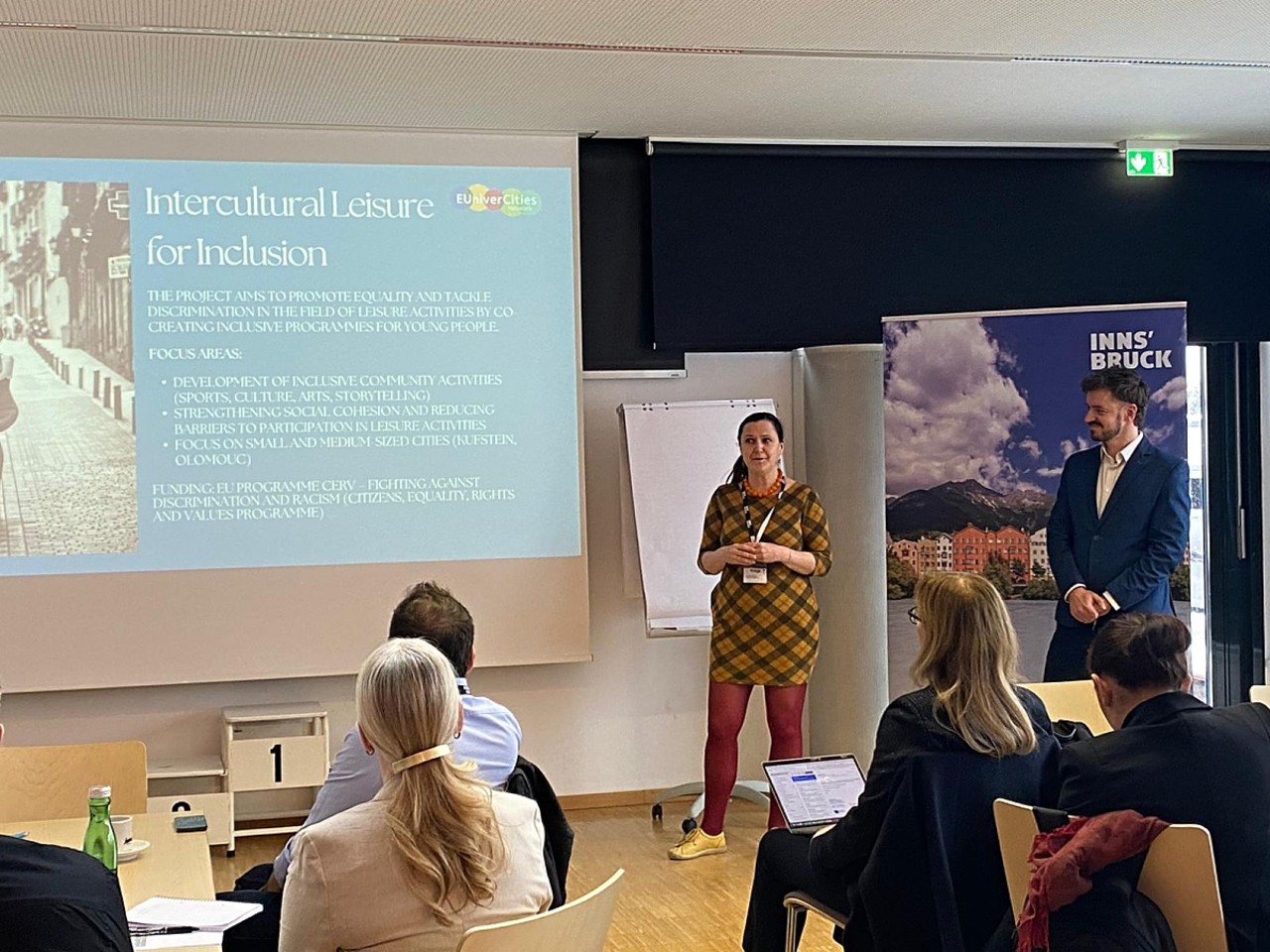
Sports as a tool for healthier and more cohesive cities was the central theme of this year’s EUniverCities network meeting, which was also attended by Palacký University. Representatives from universities and cities across Europe gathered in Innsbruck, Austria, to share experiences on how physical activity can strengthen public health and social cohesion.
Discussions and concrete examples from practice showed that sport today significantly transcends its traditional role. It can contribute to improving quality of life, prevent social isolation, or help bridge gaps between different population groups. It is precisely the intersection of sport, urban planning, and public health that is thus coming to the forefront of European cities’ interests.
Cooperation between the University and the City
The Olomouc delegation consisted of representatives from the Faculty of Science and the Rector’s Office of Palacký University, along with representatives of the City of Olomouc. According to them, their joint participation confirms that without close cooperation between the academic sphere and local government, such topics cannot be effectively developed. “It is very enriching to see how sports and physical activity are utilised right here in Innsbruck and how the city and scientists have been collaborating on joint research over the long term. It was also inspiring for me to see how other cities collaborate with their universities,” said Simona Šafaříková from the Department of Development and Environmental Studies at the Faculty of Science.
“It is very enriching to see how sports and physical activity are utilised right here in Innsbruck and how the city and researchers have been collaborating on joint research over the long term.” Simona Šafaříková
The meeting’s programme included not only presentations by experts from the local university and city hall but also a series of workshops focused on active mobility, promoting a healthy lifestyle, and the sustainable use of natural spaces. The topics of inclusion and equal opportunity also played a significant role—participants discussed how to adapt sports infrastructure for seniors, women, migrants, and people with disabilities.
From Inspiration to Future Projects
The programme also included field trips to projects that combine sports, architecture, and sustainable development, such as the GreenINN student housing complex. According to participants, these examples demonstrate that systematic support for physical activity can be a natural part of modern urban planning.
Participation in the EUniverCities network provided the Olomouc delegation with new contacts and concrete ideas that Palacký University, together with the city of Olomouc, intends to utilise in preparing future projects. They plan to focus specifically on areas where the promotion of health, sports, and the quality of the urban environment intersect.