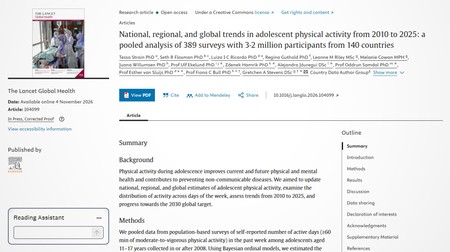
Only around one in seven adolescents worldwide manages to get at least an hour of physical activity every day, but Czech young people are more active than the global average. This is according to a new international analysis published in the journal The Lancet Global Health, which draws on data from 140 countries. One of its co-authors is Zdeněk Hamřík from the Faculty of Physical Culture at Palacký University.
The international team combined 389 surveys involving 3.2 million participants from 140 countries and tracked the number of days per week on which teenagers aged 11–17 achieved at least 60 minutes of moderate- to high-intensity physical activity. This did not necessarily have to involve sports training; sufficiently intense physical activity at school or during leisure time was also counted. A significant source of data was the international HBSC study, but the analysis also includes other population surveys.
According to the analysis, in 2025, 13.9 per cent of adolescents met the one-hour threshold on all seven days of the week. Conversely, 24.9 per cent – approximately a quarter – did not have a single active day in the week. This does not mean they did not move at all. However, according to their own responses, on no day did they accumulate at least one hour of the physical activity under consideration.
“The study does not merely track these two extreme cases. It distinguishes the full range from zero to seven active days a week. Thanks to this, schools, local authorities and sports organisations can better identify who to target when promoting physical activity. A teenager who exercises regularly may need a different approach to one who does not accumulate an hour of physical activity even once a week,” said Zdeněk Hamřík.
The Czech Republic is above average. Girls and older teenagers are less active
The global average was 2.7 active days per week. Young people in the Czech Republic have an average of four or more such days. Fewer than one in ten adolescents in the country fail to meet the one-hour threshold even once a week.
“However, there are differences underlying the favourable Czech result. Girls and older teenagers, in particular, get less exercise. It is therefore important, especially during puberty and the transition to secondary school, to find ways to keep children engaged in regular physical activity. A report on the physical activity of Czech schoolchildren from the ‘Healthy Generation’ project had previously highlighted the decline in physical activity with age,” noted an expert from the Faculty of Physical Culture at Palacký University.
The difference between girls and boys is also evident globally. For 2025, the average for girls was 2.4 active days per week, compared with 3 days for boys. Furthermore, in three regions with generally more favourable results – including Central and Eastern Europe and Central Asia – older age groups had fewer active days than younger ones. This difference was more pronounced among girls. A better average therefore does not necessarily mean that children are managing to stay active throughout their adolescence.
Physical activity is not declining. But there is still not enough of it
In both 2010 and 2025, the global average remained the same: 2.7 active days per week. In some regions, researchers noted a slight improvement, but globally they found no significant change. According to projections, no country is on track to meet the global target for 2030, which aims for a 15 per cent reduction in the proportion of adolescents who do not get at least 60 minutes of physical activity every day, compared with 2010. On the other hand, young people have maintained their levels of physical activity even during the COVID-19 pandemic and the increasing use of digital technologies.
“We can also look at it this way: physical activity has remained at a stable level for the past fifteen years, which is good news. However, this does not mean that children are getting enough exercise. In the Czech Republic, we need to focus primarily on girls and older teenagers. And we need to find ways to reach those who are not catered for by standard sports programmes,” added Zdeněk Hamřík, noting that regular physical activity benefits both physical and mental health; more active children achieve better results at school and have stronger social bonds, and the benefits of physical activity have a significant impact on health in adulthood.
How can we keep children involved in sport?
The question of how to keep children involved in sport is addressed in the draft strategy SPORT AND EXERCISE 2030+. Alongside professional sport and talent development, it focuses on the accessibility of activities and informal exercise. In practice, this could include, for example, school sports facilities that remain open after lessons or sports programmes where results are not the main focus.
“Sport isn’t just for the gifted or for those who win competitions. It’s also an opportunity to meet up, share experiences and enjoy being active. It is precisely among adolescents that we have significant room for improvement, whether in terms of talent development or spending free time actively with others. Young people are primarily looking for fun and shared experiences, but they do not have enough such opportunities. We cannot expect the health benefits alone to draw them to sport. These only become a more important motivation at a later age,” said Karel Kovář, chairman of the National Sports Agency.
Simply recommending more exercise is not enough
Opportunities for physical activity are also influenced by the environment in which children grow up. The authors of the study highlight the availability of activities, safety, and social and cultural barriers. In the case of girls, they also mention whether the range of activities on offer meets their needs and interests.
“A healthy choice must also be an accessible and safe choice for adolescents. Promoting physical activity is therefore not the responsibility of a single ministry. It requires long-term priorities for the development of physical activity, inter-ministerial cooperation between the education, sport and health sectors as well as local authorities, and the systematic creation of conditions that enable the participation of all children, with a particular emphasis on those who have the fewest opportunities for physical activity,” emphasised Zsófia Pusztai, Head of the World Health Organisation (WHO) Office in the Czech Republic.
The journey to school and the playground behind the house
Children themselves can also influence their local environment and access to physical activity through the Youth and School Forums, through which the National Network of Healthy Cities of the Czech Republic encourages the younger generation to actively contribute their views on the quality of life in the places where they live or study.
“Physical activity doesn’t just take place in gyms and clubs, but also on the streets, in parks or on the way to school. That is why towns and cities must address this issue – and they are doing so, just as they do with transport or education. Natural physical activity across all age groups can be actively promoted. This involves safe routes for pedestrians and cyclists, accessible playgrounds and sports facilities, as well as initiatives for teenagers who have not yet found their way into sport or have stopped participating,” explained Jitka Boušková, national coordinator of the WHO-UN Healthy Cities Programme.
About the study
The study National, regional, and global trends in adolescent physical activity from 2010 to 2025: a pooled analysis of 389 surveys with 3.2 million participants from 140 countries, published in the journal The Lancet Global Health, was produced by an international team of authors involving the WHO; the lead author is Tessa Strain from the University of Edinburgh. One of the co-authors is Zdeněk Hamřík, Head of the Department of Recreation and Leisure Studies at the Faculty of Physical Culture, Palacký University Olomouc, who served for approximately two years on the WHO expert group on estimates of physical activity among young people, within the framework of which the study was conducted. He thus contributed to the design of the research and brought to the team his experience from more than a decade of leading a group of 50 countries within the Physical Activity Focus Group of the HBSC study, which is one of the world’s largest studies on the lifestyle of the younger generation.