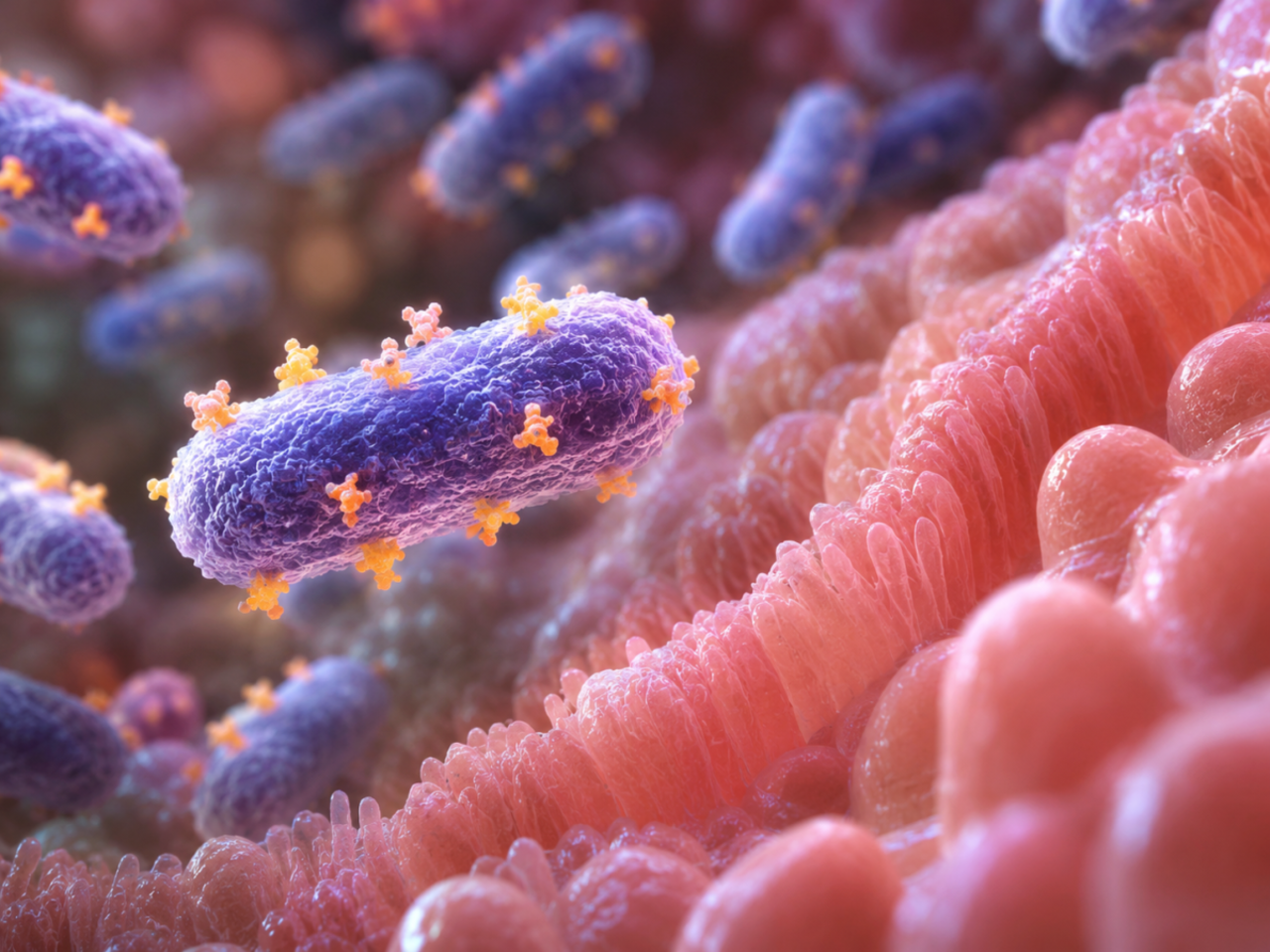
Bacteria carrying a protein on their surface that blocks one of the inflammatory signals may offer a new way to influence intestinal inflammation. A team of scientists from the Institute of Biotechnology of the Czech Academy of Sciences and the Faculty of Medicine and Dentistry at Palacký University verified this in a mouse model of colitis. The modified bacteria, administered in the diet, alleviated the symptoms of experimentally induced intestinal inflammation. The results were published in the journal Drug Delivery. The preclinical research has not yet been validated in patients.
Crohn’s disease and ulcerative colitis are chronic inflammatory bowel diseases in which an immune response damages intestinal tissue. Interleukin 23, or IL-23 for short, plays an important role in this process. It is a protein through which cells of the immune system communicate with one another. Its excessive activity contributes to the persistence of inflammation. Blocking this signal is therefore one of the aims of treatment.
Researchers have now investigated whether it is possible to intervene in this process using small binding proteins and deliver them to the gut via Lactococcus lactis, a lactic acid bacterium used in the production of dairy products. The selected bacterial strain does not permanently colonise the gut; consequently, the bacterial cells can serve as temporary producers and carriers of the active proteins. For the purposes of the research, the scientists genetically modified them so that they carry a protein on their surface that blocks the inflammatory signal.
Blocking the inflammatory signal in two ways
In the study, the team reported that they compared two proteins. The first, designated ILP317, binds directly to IL-23. The second, REX115, targets its receptor – that is, the site on the cell that receives this signal. Both thus interfere with the same signalling pathway, but each in a different way.
To enable oral administration, the researchers engineered bacteria that produce the relevant protein and display it on their surface. They mixed the engineered bacteria with plain yoghurt and coated standard mouse feed with this mixture. At the same time, they also monitored the effect of the proteins themselves when administered via injection into the abdominal cavity.
In doing so, they verified that lactic acid bacteria are able to survive passage through the digestive tract and that they continue to carry the tested proteins on their surface afterwards. “This is important for this method of delivery, as the acidic environment of the stomach often damages the structure of proteins, causing them to lose their desired binding and blocking function,” explains Petr Malý from the Institute of Biotechnology of the Czech Academy of Sciences, who participated in the study.
Reduced inflammation and damage to intestinal tissue
The researchers monitored the effect in two different mouse models of chemically induced colitis. They assessed, for example, weight loss, stool consistency, bleeding and the overall shortening of the inflamed colon. They also examined the architecture of the intestinal tissue and changes associated with the inflammatory response, such as the number of infiltrating cells. The bacteria were administered to the mice several days before the inflammation was induced and during the course of the inflammation.
When administered by injection, the proteins themselves reduced the severity of the disease. Bacteria carrying the ILP317 protein proved more effective when administered via the diet. Their effect was evident in both models. In one, for example, they reduced the shortening of the colon and the accumulation of inflammatory cells in its tissue. In the other, they alleviated the symptoms of the disease as well as damage to the intestinal mucosa. The effects of bacteria carrying the REX115 protein were less pronounced across several of the monitored indicators.
Potential for further treatment development
An advantage of the approach under investigation could be its localised action directly within the gut. According to the study’s authors, this could minimise interference with immune processes in other parts of the body. Further research is needed to confirm whether this anticipated benefit holds true in the treatment of humans.
The results to date come from two types of mouse models of colitis, which induce symptoms of the acute or chronic forms of the human disease. “Before any potential use in patients, it is necessary to verify the long-term efficacy and safety, the appropriate dosage, and the properties of the genetically modified bacteria in the human digestive tract,” says Leona Rašková Kafková from the Institute of Immunology at the Faculty of Medicine, Palacký University.
The tested strains containing the ILP317 and REX115 proteins have not yet undergone clinical trials.
Joint work by Czech and Slovenian teams
The published study is an example of interdisciplinary international collaboration. The blocking proteins were developed and characterised by Petr Malý’s team at the Institute of Biotechnology of the Czech Academy of Sciences at the BIOCEV centre, whilst the genes for these proteins were used by Aleš Berlec’s team from the Jožef Stefan Institute and the University of Ljubljana to genetically modify the bacterial strain Lactococcus lactis and subsequently characterise it. Individual strains of bacteria producing these protein blockers were handed over to Milan Raška’s team at the Institute of Immunology, Faculty of Medicine and Dentistry, Palacký University, for the development of a methodology and the functional validation of the proposed preventive and therapeutic approach in two types of mouse models of experimentally induced colitis.
Scientists from Ostrava University Hospital and the University of Ostrava also collaborated on the project. The project was supported by the Grant Agency of the Czech Republic.