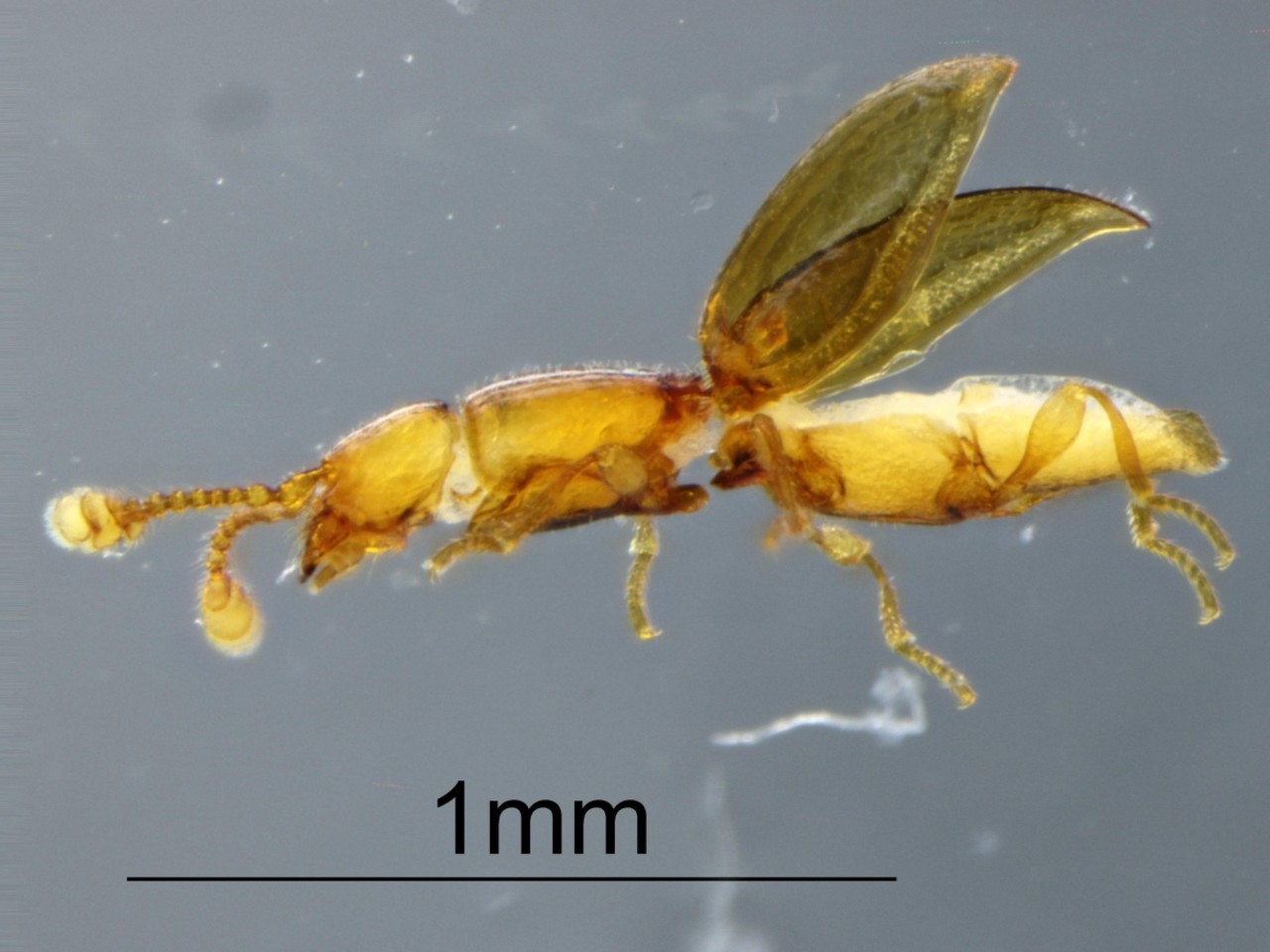
Measuring less than one millimeter, blind and wingless it was discovered by an international team of scientists deep in the soil in central Chile. The uniqueness of this miniature creature was confirmed by genetic analysis conducted by experts from the Czech Advanced Research and Technologies Institute (CATRIN) at Palacký University Olomouc. According to the analysis, the beetle comes from an ancient evolutionary line dating back approximately 220 million years. Experts have newly described this lineage as a separate family and named it Badmaateridae.
“Although the biodiversity of beetles outside industrially developed countries is still poorly researched, the identification of a completely new family is exceptional. The origin of the new Badmaateridae family dates back to the late Triassic period, approximately 220 million years ago. This means that it originated at the same time as mammals, but 60 to 70 million years earlier than birds and about 90 million years before flowering plants,” said Ladislav Bocák, corresponding author of the study and the head of the Biodiversity and Molecular Evolution research group at CATRIN.
Although this is an ancient species, the beetle, hidden deep in the soil, has so far escaped the attention of the scientific community. As a result of adapting to underground conditions, these beetles have small bodies, are blind, and wingless. Scientists involved in the international World Soil Fauna Project found several miniature individuals after digging about half-meter-deep pits, washing soil samples, and then drying the organic material.
“The appearance and body structure of the beetle provided almost no clues to its evolutionary relationships. Only some features indicated that it might be closely related to the elateroid families, which include the well-known fireflies, click-beetles, and soldier beetles. Thanks to advanced technologies, we were able to obtain a sufficient amount of DNA even from such a small individual, identify 4,200 genes, and compare them with potentially related groups. Thanks to this, we were able to confirm that it belongs to a completely new family and determine the age of this group,” explained Dominik Kusý, another co-author of the study. The beetle’s name is derived from the personal name Badamnyambuu, abbreviated to Badmaa. This was the name of the researcher who discovered the beetle while processing soil samples.
Badmaater is a new addition to the growing list of families and subfamilies whose larvae and sometimes adults live deep in the soil. However, even if other similar lineages are discovered, these specialized groups represent only a fraction of elateroid beetles. One reason may be limited knowledge of soil fauna in many parts of the world. Another possible explanation is that blind and wingless species are unable to disperse over long distances and are therefore particularly prone to extinction.
The research also shows how ancient lineages respond to climate change. The new family was found in the Chilean matorral, a specific region in central Chile which today has a Mediterranean climate with limited winter rainfall and dry, hot summers. However, for most of its tectonic history, it was located at high latitudes. At the same time, this area was isolated from the tropics by the extremely dry Atacama Desert and from the South American pampas by over 6,000 meters-high Andes. It can therefore be assumed that the region underwent significant aridification, i.e., the gradual drying up of the climate and landscape, in the late Tertiary and Quaternary periods.
“The study shows once again how limited our knowledge of biodiversity is and how important field research is – not only in tropical areas, but also in regions that are less species-rich at first glance, yet have a unique geological and climatic history and host a number of endemic species. Many of these areas are now threatened by urbanization, intensive agriculture, a low proportion of protected areas, and poor connectivity between them,” Bocák pointed out.
The unexpected discovery by scientists from Canada, Spain, and the Czech Republic was recently published in the scientific journal Systematic Entomology. The holotype will be deposited in the National Natural History Museum, Santiago, Chile. Paratypes can be found in the Canadian National Collection of Insects, Arachnids and Nematodes, Ottawa, Canada, and in the Natural History Museum, London, United Kingdom, respectively. During two expeditions in 2022 and 2025, experts involved in the project processed several tons of soil from more than 50 locations throughout Chile.